
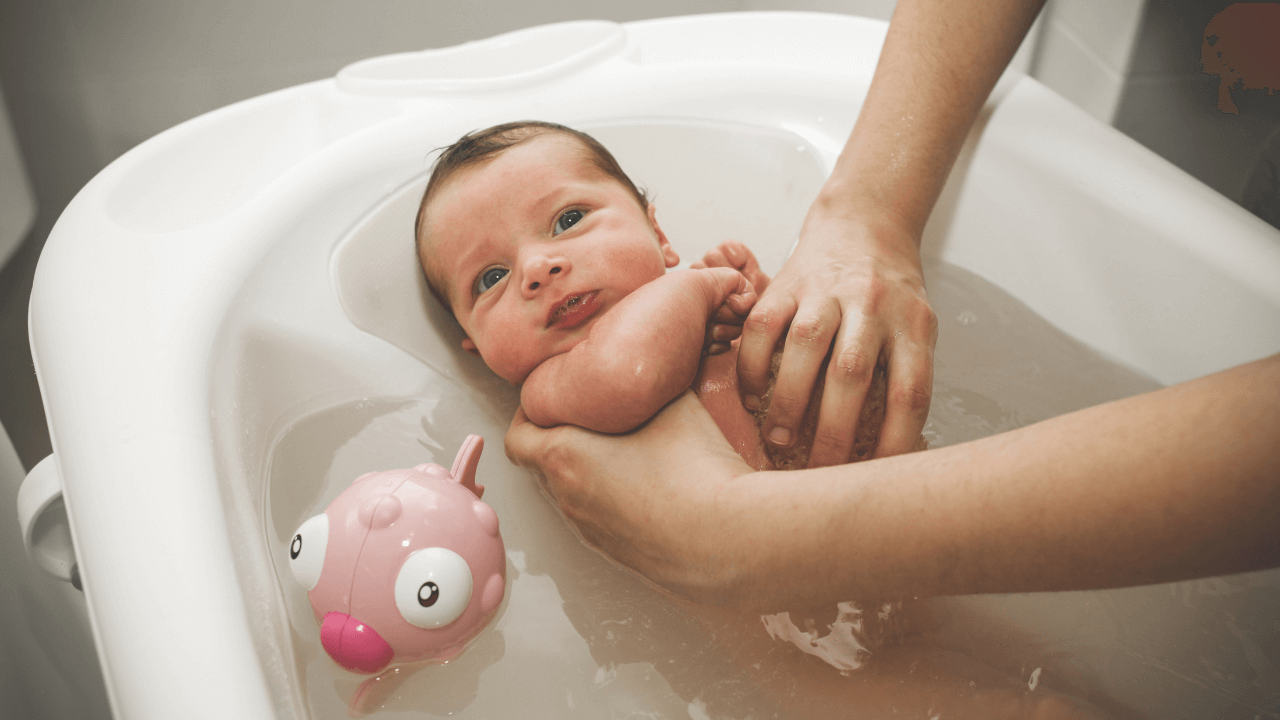
How to maintain the baby's hygiene?
A key aspect of newborn care is maintaining personal hygiene. The daily routine includes skin and mucous membrane care, umbilical cord care, and diaper area care.
Mechanical cleaning and disinfection of the skin and mucous membranes is necessary, as it stimulates receptors, has a beneficial effect on the central nervous system, and protects against infections.
Basic and partial newborn hygiene routine
The basic newborn hygiene routine includes:
- Bathing the whole body
- Umbilical cord care
- Moisturizing the skin, skin folds, and buttock area
- Care of the eyes, ears, nose, and oral cavity (when necessary)
The partial newborn hygiene routine is performed before each feeding and includes:
- Washing or cleaning the buttocks with wet wipes
- Moisturizing the anogenital area and buttocks
- Umbilical cord care
The special hygiene routine is performed when necessary and includes care of:
- Eyes
- Ears
- Nose
- Oral cavity
How to bathe a newborn baby correctly?
If there are no medical contraindications, the baby is bathed every day, and it is recommended to do so at the same time, before feeding. Bathing is performed in a warmed room at a temperature of 22-24°C, under running water at a temperature of 37-38°C. The use of neutral soap (shower gel) and baby shampoo is recommended.
For the baby's hygiene routine, sterile neutral cream or baby bath oil, anti-rash cream, and cotton pads (swabs) are used. It is necessary to prepare a set of clean diapers and clothes, a drying towel, a set of bed linen - a bottom sheet, a small pillow (in the first months, a folded diaper is sufficient), and a sheet/sleeping bag for a baby blanket or lightweight duvet.
Other supplies needed for newborn care are: 95% alcohol for umbilical cord care, sterile saline solution (NaCl 0.9%), and cotton wicks for cleaning the nose and ears.
The most convenient option for mothers is to have a special changing table and a portable changing mat in the stroller bag for diaper changes outside the home.
Before the baby's hygiene routine, the mother must wash her hands (preferably with warm water, so they are not cold when touching the newborn). She should use a clean diaper/mat on which to place the baby for the diaper change.
Bathing the baby - step by step
The newborn is unwrapped and undressed in the warmed room.
Running warm water is turned on and its temperature is checked with the elbow. When picking up the baby, the thumb is placed under one shoulder, and the other shoulder is held between the thumb and middle finger. The baby is bathed under the running water, so that the water stream falls onto the hand, while keeping the navel dry.
The shower gel or shampoo is applied to the palm and used to wash in the following order: head, face, neck, back, chest, upper limbs, buttocks, lower limbs.
The newborn is placed on a pre-prepared sterile towel and the skin is gently patted dry from top to bottom, paying attention to the skin folds, where no moisture should remain, as this leads to rashes.
Umbilical cord and skin care
A sterile cotton pad soaked in alcohol is used to carefully clean the umbilical cord stump and surrounding skin, from top to bottom. This removes blood and secretions from its mummification, which are an ideal environment for the development of infection. At the same time, observe for:
- Presence of swelling
- Redness
- Changes in shape and structure
- Unpleasant odor, which are signs of pathology of the umbilical cord stump
This is followed by moisturizing the skin and skin folds with a sterile pad soaked in oil or neutral cream (behind the ears, neck folds, underarms, arm and leg folds, around the genitals, back, abdomen, legs, and anus).
The newborn is then wrapped or dressed. If necessary, special care of the eyes, ears, nose, and oral cavity is performed. Wet wipes may be used for the partial hygiene routine.
Care of eyes, ears, nose, and oral cavity
Eye care
- A sterile cotton pad is soaked in saline solution
- With a single movement, one eye is wiped from the outside inward (toward the tear duct)
- It is dried with a dry sterile pad in a single movement from outside inward
- The process is repeated for the other eye
Ear care
- The newborn is placed lying down with the head to one side, and the ear is gently pulled upward and backward
- The ears are dried with a dry sterile swab, without inserting it into the ear canal
- If dirty, the outer ear is cleaned with a sterile pad soaked in saline solution
Nose care
- This is performed when dried secretions are present. The nasal cavities are coated with sterile neutral cream and left for 10-15 minutes
- A cotton wick soaked in saline solution is then used with a rotating movement to clean one nostril
- Another wick is used to clean the other nostril in the same way
Oral cavity care
This is applied only by medical prescription in cases of abundant whitish deposits (thrush), before the application of antifungal agents. For dried secretions around the oral cavity, these are cleaned with a sterile pad soaked in saline solution
The procedure is performed in a well-lit room. The newborn's head is turned to face the mother. The oral cavity is cleaned with a spatula wrapped in gauze soaked in saline solution. A spatula soaked in an antifungal preparation is used to wipe the tongue, palate, and inner cheeks.
Supplies needed for newborn care
- 95% alcohol for umbilical cord care
- Sterile saline solution (NaCl 0.9%)
- Cotton wicks for the nose and ears
- Baby oil, anti-rash cream
- A set of clean diapers and clothes
Follow the "Birth at VITA" Facebook page for more helpful newborn care tips!
 On this page, you can change your choices at any time after you have read and understood our