
Information
Lipofilling (from Lat. lipo - fat, and Eng. "filling") is a modern surgical technique for transferring a person's own fat tissue from one area of the body to another. It is used to add volume and sculpt body contours, to fill in uneven areas with a fat deficit, in facial rejuvenation, for facial or breast reconstruction, and for buttock shaping. Lipofilling uses the patient's own fat cells, taken from areas of the body (donor zones), which are then transferred to the areas where they are needed (recipient zones).
What does the surgical technique itself involve?
Preparing for the surgery
Before the surgery begins, the donor zones are determined - the areas from which the fat tissue will be taken. These are usually: the inner part of the knees, the thighs, the abdomen, the upper inner part of the arms, the so-called "love handles," as well as certain parts of the back or waist.
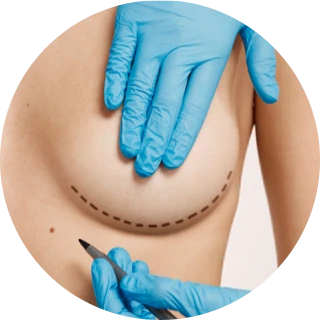
Once the area from which the fat will be taken has been determined, the amount of fat tissue that needs to be taken is marked out and assessed in advance. The area into which the harvested material will be injected is also marked out. The next step is to photograph the donor and recipient areas, so that the results before and after the surgery can be compared.
The anesthesia for this type of surgery can be local (when performed over a very small area) or general (for larger areas). The duration of the surgery also depends on the size of the areas being treated.
Harvesting and processing the fat tissue
The removal of fat cells from the donor sites, also called "harvesting," is done by liposuction. Small incisions are made at the most hidden points or in the folds of the chosen area, and special suction cannulas are inserted through them, which aspirate the fat tissue.
Cannulas come in various models. For lipofilling, thin, fine cannulas of varying diameter thickness (2-3 mm) are used. Depending on the depth from which the fat is taken, an appropriately sized cannula diameter is chosen. The more superficial the level from which it is aspirated, the thinner the cannula should be.
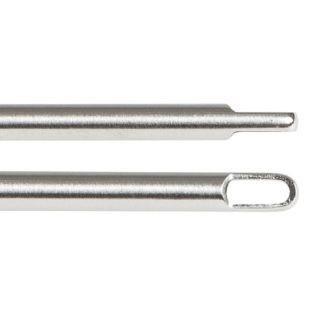
Suction cannula
After the fat volume has been aspirated, the fat cells are separated out as a cellular fraction by settling (centrifugation). This cellular material is transferred into syringes of 1, 5 or 10 ml, depending on the volume that needs to be infiltrated into the recipient area.
Injection and graft survival
The injection of the fat cells is done again with a special injection cannula, whose diameter is usually smaller than that of the suction cannula used previously.
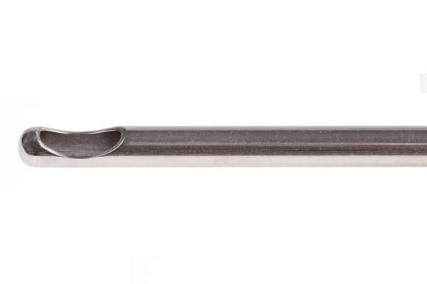
Injection cannula
The nourishment of the transferred fat in the recipient area is initially provided by the surrounding tissues, but new blood vessels gradually grow into it, providing its subsequent nourishment. Part of the injected fat is resorbed by the body, for several possible reasons. In larger fat particles, the ingrowth of small blood vessels is more difficult, which leads to improper nourishment and subsequent death of the cells. Another factor is disruption of the integrity of the fat cell during its transfer, which also leads to its death.
What is the recovery period like?
The recovery period depends on the patient's age. It usually proceeds mildly, with sensations resembling muscle soreness. Bruising and swelling may be present both in the donor and in the recipient area. It is important to wear compression garments after the surgery for a period of 4 weeks, covering the donor areas. This reduces the formation of swelling and helps the skin adhere more easily and quickly to the underlying soft tissues. This does not apply to the recipient areas, since compression would interfere with the formation of new blood vessels in the fat grafts.
What are the risks of lipofilling?
Like any other surgery, lipofilling also carries certain complications. Although extremely rare, these include bleeding, severe and painful swelling, infection, and temporary loss of sensation in the treated areas. To reduce the risk of complications, it is sufficient to strictly follow the surgeon's recommendations.
What are the advantages and disadvantages of lipofilling?
Lipofilling is a procedure with many advantages, but it also has its drawbacks.
Advantages:
- The greatest advantage is the use of the patient's own tissues, which minimizes the risk of allergic reactions
- Rejuvenation and tightening of the tissues, both in the recipient and the donor area
- Low risk of complications
- Minimal scarring
- Fast recovery
- Part of the injected fat remains permanently
Disadvantages:
- In very thin patients, lipofilling is practically not feasible, due to the lack of a well-developed donor area
- Loss of fat tissue after the surgery, due to hormonal imbalance or overall weight loss, also leads to the disappearance of the injected tissue
- Only about 30-50% of the injected fat tissue remains permanently - this may require repeating the procedure to achieve the desired result
 On this page, you can change your choices at any time after you have read and understood our